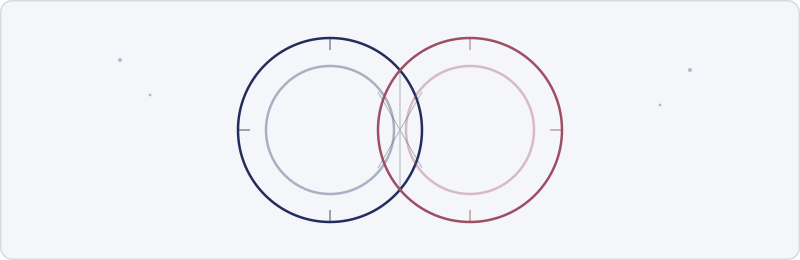
Synastry is the branch of astrology that compares two complete birth charts against each other, planet by planet, to describe the pattern between two people. It’s the technique behind almost every “compatibility” question worth asking, and it’s the core method Two Skies uses for every reading on this site. This page walks through what synastry actually does, what it doesn’t do, and how to read a synastry overview without over- or under-reading it.
What a synastry comparison actually is
Start with two ordinary birth charts — yours and the other person’s, each built from a birth date, and ideally a birth time and place. A synastry chart overlays them, then measures the angle (the “aspect”) between every planet in chart A and every planet in chart B. Your Venus might sit sixty degrees from their Mars. Your Moon might sit exactly opposite their Sun. Each of those angles gets a name and a general tendency attached to it, and the sum of all of them is the synastry picture.
Nothing about that overlay is mystical. It’s closer to comparing two maps and noting every place they intersect. The interpretation — what a given angle “means” for two real people — is where astrology’s older, more textbook-like tradition comes in, and where we try to stay disciplined about language: tendency, not verdict.
The aspects that carry the most weight
A handful of angle types come up constantly in synastry work:
- Conjunction (0°) — two planets sitting on almost the same point. This tends to intensify whatever those two planets represent, for better or worse depending on which planets they are.
- Trine (120°) — an easy, flowing angle. Trines usually describe things that come naturally between two people, with little friction.
- Square (90°) — a friction angle. Squares are often where the real work of a relationship happens; they’re uncomfortable but not automatically destructive.
- Opposition (180°) — a pulling-in-two-directions angle. Oppositions can describe genuine complementary balance or a persistent tug-of-war, depending on the planets and the people.
- Sextile (60°) — a milder, supportive angle, generally easier to work with than a square but with more texture than a trine.
None of these are inherently good or bad placements to have between two charts. A square between two Marses can show up as constant bickering in one couple and as a competitive, energizing dynamic that keeps both people sharp in another. The chart shows you the angle; you and the other person are the ones living out what it becomes.
Which planets matter most in a relationship reading
Every planet in each chart technically has an angle to every planet in the other chart, but a handful of pairings do most of the descriptive work:
- Sun to Sun, Sun to Moon — describes how your core identities and emotional habits interact day to day.
- Venus to Venus, Venus to Mars — describes affection style and attraction; this is the pairing most people mean when they ask “are we compatible.”
- Moon to Moon — describes emotional rhythm: whether your instinctive reactions to stress, comfort, and routine run in sync or in contrast.
- Saturn to personal planets — describes commitment, boundaries, and where the relationship gets tested over time rather than in the honeymoon phase.
- Mars to Mars, Mars to Venus — describes how the two of you handle conflict, drive, and desire.
What synastry can’t tell you
It’s worth being direct about the limits, because the domain this site now lives on used to promise the opposite. Synastry cannot tell you whether a specific person will stay, whether they’ll come back, or whether the relationship is “meant to be.” It doesn’t override someone’s choices, and it isn’t a lever for changing how another person feels about you. Two charts can line up beautifully and the relationship still not work, because compatibility on paper and compatibility in daily life are related but not identical questions. Two charts can look genuinely difficult and the relationship can still thrive, because two people who choose to communicate well can outperform what a chart alone would predict.
What synastry is actually good at is naming things you’ve probably already half-noticed — a recurring argument, an easy rapport, a specific kind of friction — and giving you vocabulary for it. That’s a real, useful thing. It’s just a different thing from a guarantee.
How to read your own synastry overview without over-reading it
A few habits make a synastry read more useful and less anxiety-inducing:
- Look at the overall pattern before fixating on any single aspect. One hard angle in an otherwise easy chart matters less than three hard angles clustered around the same planets.
- Treat “difficult” aspects as a prompt to notice something, not as a prediction of doom. Most long relationships carry some friction aspects; it’s part of how two different people fit together.
- Weigh the read against what you already know about the relationship. If the chart says something that doesn’t match your actual experience, trust your experience — the chart is a lens, not the final word.
- Remember that a full synastry read benefits from birth times for both people, since house placements add another layer (which part of life a given angle plays out in). A date-only read is still informative, just less specific.
Where synastry fits with the rest of a relationship read
Synastry is usually the first layer, but it’s not the whole picture. A composite chart looks at the relationship as its own separate entity built from the midpoints between two charts. A closer look at Venus and Mars specifically narrows in on affection and conflict style. And relationship timing — the transits moving over both charts right now — adds a “why does this feel different lately” layer that a static synastry comparison can’t capture on its own. Together, the four give a fuller, still honestly limited, picture of two people and the pattern between them.